# Rebel Starter Pack
The Rebel Starter Pack may be your very first link to Extinction Rebellion. It covers some of the basics of what XR is and a few tips about where to start.
This handbook has been put together by the UK Rebel Pathway team.
# Rebel Starter Pack Printable PDF
The **Rebel Starter Pack** may be your very first link to Extinction Rebellion. It covers some of the XR basics and a few tips about where to start.
[Link to printable PDF](https://cloud.extinctionrebellion.uk/s/z8s5AAi284RtePZ)
[Link to black and white printable PDF](https://cloud.extinctionrebellion.uk/s/2HSXAHpDKtSrKeF)
Produced by: UK Pathways Team (last updated Feb 2023)
Or go back to the [Rebel Toolkit version](https://rebeltoolkit.extinctionrebellion.uk/books/rebel-starter-pack)
[](https://cloud.extinctionrebellion.uk/s/AB78WFxpS43QEK2)
# Introduction
The science is clear: we face an unprecedented **climate and ecological global emergency.**
**Extinction Rebellion (XR)** is a worldwide movement using nonviolent civil disobedience to force institutions to act on the crisis.
This pack is your introduction to Extinction Rebellion UK: our goals, the principles we stand for, our ways of working. But most importantly, it’s your guide to taking part.
[>> NEXT PAGE: What is the Climate and Ecological Emergency](https://rebeltoolkit.extinctionrebellion.uk/books/rebel-starter-pack/page/what-is-the-climate-and-ecological-emergency)
[>> Back to Rebel Start Pack CONTENTS](https://rebeltoolkit.extinctionrebellion.uk/books/rebel-starter-pack)
# What is the Climate and Ecological Emergency?
##### Our video **'Heading for Extinction and What to Do About It'** explains the emergency (50mins). To watch, click [here](https://www.youtube.com/watch?v=2RfREWG3Fxo&t=10s)
(November 2022) with Bors Hulesch
Please see [this page](https://rebeltoolkit.extinctionrebellion.uk/books/rebel-starter-pack/page/dealing-with-climate-grief-anxiety) for support with climate grief and anxiety
[>> NEXT PAGE: What do we want to achieve](https://rebeltoolkit.extinctionrebellion.uk/books/rebel-starter-pack/page/what-do-we-want-to-achieve)
[>> Back to Rebel Start Pack CONTENTS](https://rebeltoolkit.extinctionrebellion.uk/books/rebel-starter-pack)
-----------
##### Transcript from earlier, shorter, version of this talk:
(August 2020) with Bors Hulesch and Sara Hudston
[Music]
Climate change is quite simply
an existential threat for most life on
the planet, including and especially the life
of humankind.
[Music]
Hello. I'm Sarah Hudson and I'm a writer.
I joined Extinction Rebellion in 2018
because i was so concerned about the
destruction of the natural world.
In March 2019, I trained as a speaker and
I've been giving the talk *Heading for
Extinction* in many places all across the South West.
Hello. My name is Bors. I originally
trained as a social scientist
and later on as a climate scientist. I've
been a member of Extinction Rebellion
since March last year and I've been a speaker
since August last year. I have the great
privilege to be one of the editors
of this talk and I'm super excited to
give you this short
30 minute version together with Sarah.
On this video, we'll talk more about Extinction
Rebellion shortly but, for now, here's a
very brief introduction.
We are a non-violent direct-action, civil-protest organization.
We're everyday citizens
looking for a solution to the climate
and the ecological emergency.
We have recognized the individual action
is not going to be sufficient to tackle these
crises. Therefore we must get governments, both
national and international, to take decisive
action on our behalf. They must support and
protect us as they pledged to do when they came to
power.
The world's most pressing problems are
closely interlinked. At the heart of it all is power.
Power, financial and governmental, is
concentrated in the hands of a very
small minority of humanity.
Think political leaders. Think global
corporations. Think financial
institutions.
This concentration of power doesn't care
about the damage it does to the earth.
The concentration of power means that
gross inequalities are perpetuated.
It's
impossible to do justice to global
justice in just one slide
but here are some examples. People of
colour are disproportionately affected
by the adverse effects of climate change
in the Global South
and even within industrialized nations
such as ours. People of color are dying of Covid at
twice the rate of white people. People of colour are also
disproportionately affected by air
pollution, have lower life expectancy, have less
access to education
and suffer more police brutality.
Many movements are advocating for
justice and for a more equal
distribution of power and resources.
Extinction Rebellion stands with Black
Lives Matter.
We also advocate for equal rights for
everybody, including LGBTQ rights, refugee rights
famine, water, stress or air pollution.
Our civilization is more fragile than we
like to think. The Ccovid-19 pandemic shows how
vulnerable even our big, strong technological
society is. It gives us a timely clue what the much
bigger and nastier monster of climate
change would be like. Going back to business-as-usual
is not an option.
Now, we have this lovely,
wonderful, one-and-only planet which is
reasonably habitable at the moment. But
we are destroying it
in many different ways. The two big ways
that we're destroying it
are climate destruction and ecological
destruction. They're both very important for
different reasons
and I'm going to start by talking a
little bit about how
the climate is being destroyed.
Now, when we talk about climate,
we mean weather systems, everything to do
with the ocean currents, the temperatures
both on the surface,
in the air and in the oceans as well.
We mean stuff like glaciers and how much
they melt. All of that stuff is climate.
When we talk about ecology and ecological
destruction, we mean species.
We talk about plants and animals as well as
humans.
What you see on this slide has been very
aptly named the hockey stick graph. It's a very
famous chart and it has a long history, and it has
been contentious in the past.
The basic tenets of it are beyond
reproach and beyond question now, and
here's what this graph does.
It maps out the carbon dioxide levels in
the atmosphere for the past 2000 years.
The main thing that you're seeing is
this nice flat line going across
at about 280 parts per million,
and that means that the carbon dioxide
levels were pretty much even. Yes, there
is some fluctuation but it's pretty much
at that level. That carbon dioxide level gave us a very
similarly level flat and clement climate
during the past 2000 years.
I'll show you another squiggly line in a minute.
There won't be any more squiggly lines, I
promise, but just these
two.
The carbon dioxide levels when the
industrial age begins,
they start to skyrocket. Why is that?
Because we're burning fossil fuels,
specifically coal oil and gas.
once those fossil fuels begin to be
burned in earnest,
the carbon dioxide concentration
in the atmosphere goes right
up.
The other thing that we need to
observe is the temperatures.
The little squiggly line on the
right hand side of the chart in blue
is global temperature records. Now
we've only got
actual proper temperature records from
from measurements of temperature
since the year roughly 1850,
so that's what we have.
You can see on the chart
that the temperatures increasing
up to 1.1 degrees above pre-industrial
levels is very much trending together with the
CO2 levels.
There has been a number of studies
across decades which have tried to see if there's any
other correlation
that's worth looking at or worth
mentioning in terms of the increases of
temperature.
So, solar activities - the wobble of the
Earth, the Milankovic cycle, all sorts of
stuff - and, yes, these things exist. But actually,
they have been all excluded
from the temperature rise that we are
observing on global average temperatures today.
Now why is this important? Because
this is the curve that we have an
influence over. We can't influence global cycles and
solar cycles, but we can influence carbon
dioxide emissions in the atmosphere.
And it is beyond proof now that if we
can bring down those carbon dioxide levels
then we will also be helping the
temperatures not to rise any further.
And, in the very long run, also to come
down again.
This is my other squiggly line, and the
last one in this deck.
What this line shows you is global
average temperatures across the last
five million years.
As I've mentioned before, you have
actual records only for the past 170
years or so.
But, before that, you have reconstructions,
and the reconstructions are based on a
great deal of different science.
And, I have to say, this squiggly line
here represents
much more science than getting to the
Moon. There's just incredible amounts of
thousands of man-years' worth of climate
science in this line.
The closer you come to the present
day, the more accurate the line gets.
But, even as far back as 5 million years,
it is pretty accurate.
I'll talk you through the straight lines.
First, you've got the green straight line
coming across the middle. That's the zero, the
pre-industrial average temperature on
the surface of the planet.
You've got a two degree line above it,
which is two degrees
above that pre-industrial average. We're
kind of halfway in between those two
right now.
And then there's a four degree line as
well on top of that.
And, if you look at the squiggly line, you
can see that the last time it was at least two
degrees warmer than the pre-industrial
average is 130,000 years
ago. And the last time
it was at least four degrees warmer than
the pre-industrial average
was about 4-5 million years ago.
Now, why is this important? That's because
human civilization has only existed in
the last 10,000 (arguably 20,000) years, and we have
not got any idea of whether human
civilization is
able to exist in this two degree world
because we haven't tried it.
The human species evolved about two
million years ago
so, again, we have no idea whether the
human species is able to exist
in a plus four degree world. This is the
big experiment,
and if we screw up, there is no way of
going back.
Now we need to understand that climate
change is not something that's into the
distant future.
30 years or 50 years from now, it is
happening. It has been happening, and the effects
are already noticeable today.
We are now at 1.1 degrees Celsius
increase in global average temperatures,
which actually on land is even greater.
And actually, a large proportion of
the human race is currently even living
under conditions of 1.5 or more!
But the point is that climate change
is now. It's not sometime in the future. And some
of the most important impacts of climate
change have to do with
not enough water and too much water and,
of course, heat.
So, the four examples we have on
this slide:
- the first one is about
drought: not enough water,
which leads to crop failure, it leads to
to people and animals dying as well. The other one is wildfires,
so we know about Siberia, Australia, California -
we also have wildfires on on these
shores, and the greatest wildfire seasons in
known in history in the UK.
- on the other hand,
we have floods on seashores as well as
floods inland when there is a river,
and we have sea ice melt and
sea level rise. Now, sea-level rise is not
just about the sea ice, because sea ice is
roughly already 90 percent inside the
water so it doesn't cause that much sea
level rise. But
ice sheets that are sat on top of land
such as in
Antarctica and in Greenland, if they
fall into the water, they can have a
tendency to give rise to a great deal of sea level
rise. Also, thermal
expansion of the water as it heats up.
And we talked about
1.1 degrees, which is what we have today,
but what happens
by mid-century and by the end of the
century?
Well, a lot depends on what we do as
a species:
what kind of decisions we make, how we
cut carbon emissions.
But, on the current trajectory, even if we
agree to uphold the climate agreement of Paris
2015, we're on course for something like three
degrees of warming by the end of the
century.
We're not on track to meet those targets
so, right now, the thinking is
anywhere between four and five degrees
of warming globally on average
by the end of the century and two
degrees by mid-century.
Now the Paris Agreement says that we
should be staying below two degrees but
we're not actually doing so
at the moment, so let's have a look at
what might that mean
for the planet and for us as a species.
World hunger has been on the decline for
years and, for the first time, it is going
up again. Extreme weather events are going to
increase in frequency
and intensity and devastation, both in
terms of human sacrifice, human cost but also
financially.
So there is an estimation that, by 2050,
you're going to look at a trillion
dollars worth of coastal damage every
single year, until there's nothing left on the
coasts.
The next thing is water shortage and
there is already quite a lot of water
shortage but, in just
five years' time, about four billion
people are going to be looking at being short
of water. That doesn't mean they don't
get any water but that there's a water
stress going on.
And, by mid-century, you could be looking
at a billion people
having severe shortage of water.
When these kinds of events occur, you're
going to see displacement of people
because people would rather move than
die. And that's pretty understandable! By
mid-century, the projections are (and this is part of
my dissertation by the way)
somewhere between 200 million to a
billion people might need to move. And that kind of
displacement is completely
unprecedented in the history of this planet.
Every year
is so important. Every year you leave it,
the later you leave it,
the worse it gets. The later you leave it,
the more difficult it gets to climb down
from the carbon dioxide levels in the
atmosphere.
If we had started earlier, and
we've known for a while that we need to
do this,
then the curve would have been a much
more pleasant one, maybe a reduction
of 3%, 4% or 5% year on
year. Now, it's more like 10-15% year on
year.
And, if you look at what happened with
Covid-19 this year,
typically in an average year you get a 3%
increase in carbon dioxide emissions
and this year, we have
projected to some something like 4 or 5
percentage points reduction! So, when you
add the 3% and the 5%, you
get something like 8%
reduction in carbon emissions.
If you consider how many cars have
stopped, how many
flights have stopped, and yet we've only
achieved 8% reduction in our
global emissions.
You can see the scale of the problem!
Even that, even Covid-19 has failed to achieve just
one year of required reductions.
In order
for us to get to net zero, we need to
pull our fingers out
and do something radically different to
what we're doing today.
I'm going to finish here as regards the
climate emergency,
and I'll let Sarah explain a little bit
about the ecological emergency.
In addition to the climate,
there is also a crisis in the biosphere,
the ecology, the web of living beings
that sustains us all.
Humans depend on a healthy natural
environment for our well-being
and our survival. In 2019,
a hard-hitting international report
backed by the United Nations had these
things to say about the impact of humans
on the planet:
- Nature is declining globally at rates
unprecedented in human history, and the rate of species
extinction is accelerating.
- Around a quarter of species are already
threatened with extinction.
- Species are being destroyed at rates at
least 10 to 100 times higher than the
background.
- Average extinction rate over the last 10
million years - humans affect
three-quarters of land, two-thirds of the
oceans, three-quarters of fresh water, leaving
little room for anything else.
- 85% of wetlands have
been destroyed.
The chair of the organization that
produced that report said:
"we are eroding the very foundations of
our economies, livelihoods, food security, health
and quality of life worldwide."
A mass extinction of species is already
under way.
There have been five previous mass
extinctions in the Earth's history.
The last one was 66 million years ago.
The current one is caused by exploding
human consumption,
not natural events.
What's more, we humans
know that it's happening and why. That's
why it's better called an extermination.
Today, by biomass, the mammals of the
world are represented like this: 60%
livestock, 36% humans and only 4% wild.
So what do we need to do? Well, we need to
do everything! We need to do all sorts of
things, but there is one
specific, particular thing that if we
don't do we are definitely going to fail.
This is the dragon that we need to slay.
In very short, it is CO2. We need to reduce carbon
emissions. We need to reduce CO2 levels rapidly,
completely and for ever. There's no way
around it. If we fail to do this, we will
have failed.
All the other things that we could be
doing and we should be doing
are insufficient if we haven't reduced
CO2 emissions.
Individual, personal action will
fail. The only way to do this is through
international organizations,
international corporations,
national governments.
Now, if you ask the
UK Government
what it has done in the past on CO2, it
will be more than happy to tell you
that they have reduced from 1990 levels
the CO2 emissions of the
country by 40%.
And, in their accounting, that might be
true. But we know that, when you add
aviation and shipping
as well as all the goods that we no
longer manufacture here but somewhere
else and we're importing and using them
here -
if you add those three things up,
actually the UK carbon emission levels
have stayed pretty much level. Not a lot
has changed.
We've tried a number of different things.
There are international treaties
such as the Climate Agreement in Paris
2015. We did also have the Kyoto
Protocol in 1995.
Governments have done climate change
legislation, such as the
Climate Change Act of 2008 in the UK.
We are also litigating governments -
there's thousands of lawsuits going on in many
different countries about that.
We have our personal commitments. We have
our activist organizations such as
Friends of the Earth, WWF,
Greenpeace. And, all of those things put
together,
what have they achieved? All you need to
do is look at this graph.
If there is a tailing off and dropping
off then they're right.
If there isn't then we're not making
progress.
This is your check. Check this graph.
The rules that govern us today have got us to this
place, and we know that when those rules don't
work for us, they need to be broken.
Breaking the rules has a noble
and long-ranging tradition. Some examples
include:
- Gandhi, who broke the rules in order to
stop colonial power in India;
- Rosa Parks, who famously refused to give up her seat
to a white man on a bus
and and triggered the civil rights
movement in the US;
- and then Martin Luther King Jr, who led the
movement and brought millions of people out onto the
streets and to force
these changes to discriminatory laws.
You may have noticed also that
Governments and people in power
prefer not to hand out rights
to the population without some degree
of pressure.
You can think about voting rights,
women's suffrage, gay rights,
discrimination, racial and otherwise.
You can think about the Velvet
Revolution in 1989
in Eastern Europe, where I come from.
And you can think about apartheid.
So there's always some kind of pressure
from grassroots, from down below, that
pushed these governments to make the
changes that were required.
The people that put this pressure on at
the time were considered criminals, perhaps, or bad
actors.
But now they're considered heroes in the name of
a righteous cause
Civil resistance, otherwise called
non-violent direct action and non-violence, is
really a crucial part of this.
We call it Non-Violent Direct Action
within Extinction Rebellion.
It is when otherwise peaceful
law-abiding citizens
like you and me go on to break the law
and put themselves in the way of the
government in order to
achieve an objective.
A regime
that refuses to change needs to be
changed, either by getting them to do the things
we want them to do or by removing the
regime.
Altogether, the main strategy and the main tactics
of Extinction Rebellion is through actions.
So we are on the streets. We are taking
actions - disruption which causes both the government to take
notice but also the general population
and the media to take notice.
Sarah will tell you a little bit about
what an action
can look like and why arrest is an
important part of the actions that we
take.
In order to be able to carry out
disruptive actions and create dilemmas
for the authorities,
we need people who are willing to do
things that risk
being arrested. Arrest itself is also a
form of disruption,
as it uses police resources and court time.
We have found that our court cases have
created thousands of opportunities
to present the issues to the judiciary
and reach one part
of the establishment. However,
for every person who is what we call an
'arrestable' - that is, somebody who is
willing to put themselves in a position
where they may be arrested -
there are more than 20 other people who
are part of the movement,
who support them. And they help the
movement in other ways.
We have artists, writers, samba band
musicians, cooks, organizers - the list goes on and on.
Joining Extinction Rebellion doesn't
mean that you have to get arrested.
You don't!
There are so many other ways you can
help, and we need you
whether you have an hour a week or are able
even to give up your job to work full-time for the movement!
I particularly want to draw your
attention to our top tasks,
as these are part of our mass-mobilization strategy.
These are:
- leafleting and stalls;
- phone banking;
- door knocking;
- giving this talk;
- and house meetings.
If you can do any of these things, you
can help grow the movement as fast as
possible.
Civil disobedience works best when it's
a mass movement,
one which is broad and diverse. We want
to have one million people actively involved.
"I do feel that there are two
types of laws.
One is a just law, and one is an unjust
law. I think we all have moral obligations to
obey just laws. On the other hand, I think we
have moral obligations to disobey unjust
laws because
non-cooperation with evil is as much a
moral obligation as is cooperation with
good. I think the distinction here
is that, when one breaks the law the
conscience tells him is unjust,
he must do it openly, he must do it
cheerfully, he must do it lovingly, he must do it
civilly not uncivilly,
and he must do it with a willingness to
accept the penalty. And any man who
breaks the law that conscience tells him
is unjust and willingly accepts the penalty by
staying in jail in order to arouse the
conscience of the community on the
injustice of the law.
is at that moment expressing the very
highest respect for law."
We have three big, clear demands.
The first of these is that government and
the media tell the truth about the
situation that we're in.
We need to make sure that everybody
understands the basic science behind our
situation. We want good, clear information about
this, not like the lies and the confusion
that we've seen from some governments
over the coronavirus pandemic!
The second demand is for the government
to set a legally binding target to reduce greenhouse gas
emissions to net zero by 2025.
The third demand is for a citizens' assembly
to decide how to address these issues.
Their recommendations must be legally
binding. They will be commissioned and funded by
the Government,
but independently organized and run.
XR will not be involved in the running
or the setup of the assembly.
The aim is to strengthen democracy, so
independence is absolutely key.
So the Citizens' Assembly brings together a
randomly selected group of citizens,
and they're brought together and, over a
period of time, they're facilitated to
learn to deliberate and to come to
decisions and recommendations.
What's really important about citizens'
assemblies is that they aren't run by
directly by government. Government may
give them a task, it may sponsor the
assembly, but the assembly is organized
by an independent, trusted organization,
typically a civil-society organization,
and the facilitators working in that
citizens' assembly are independent.
You don't need permission to get involved
with XR. You can visit the website for
all sorts of information.
You can read about our demands, our
values, our events,
our groups. You can also sign up for the
UK newsletter.
I want to leave you with two key
takeaways from this talk.
The first of these is: do not think for a
minute that your own personal commitments to
the environment are going to be enough,
not on their own. They're not. We need to
put pressure on governments together.
The second thing i want you to remember
from this talk if you remember nothing
else: do not believe for a second that we and
XR have got your back,
and that you can sit back and relax and
let us go and take action on your behalf.
We need more people. We need you.
Your planet needs you. Life itself
needs you!
[>> NEXT PAGE](https://rebeltoolkit.extinctionrebellion.uk/books/rebel-starter-pack/page/what-do-we-want-to-achieve)
# What do we want to achieve?
#### We have **three demands.**
Included here are some additional videos _(not included in the printable pdf)_.
##### **1.** **TELL THE TRUTH**
**All institutions must communicate the danger we are in.**
We are facing an unprecedented global emergency. Life on Earth is in crisis: scientists agree we have entered a period of abrupt climate breakdown, and we are in the midst of a mass extinction of our own making.
[Heading for Extinction: Part1. What's happening and why](https://youtu.be/QME0nzk1BSQ)
##### **2.** **ACT NOW**
**All society must reduce emissions to net-zero by 2025 & protect and repair nature.**
We are unprepared for the danger our future holds. We face floods, wildfires, extreme weather, crop failure, mass displacement and the breakdown of society. The time for denial is over. It is time to act.
Conventional approaches of voting, lobbying, petitions and protest have failed because powerful political and economic interests prevent change. Our strategy is therefore one of nonviolent, disruptive civil disobedience – a rebellion.
Historical evidence shows that we need the involvement of 3.5% of the population to succeed – in the UK that’s about 2 million people.
[Heading for Extinction: Part2. What to do about it](https://youtu.be/cmRmzDk6JrQ)
##### **3.** **DECIDE TOGETHER**
**Citizens' Assemblies to decide now.**
If we are to have any hope of coping with the emergency, we have to move beyond the politics that have so far held us back, and into listening, dialogue and towards unity and action.
Extinction Rebellion does not want to seize power, we want power to be in the hands of the people. We need to decide together. That’s why our third demand is for a Citizens’ Assembly on Climate and Ecological Justice.
[Why have a Citizens' Assembly](https://www.youtube.com/watch?v=QVo2WF3-FP8)
[>> NEXT PAGE: Why do we need to rebel?](https://rebeltoolkit.extinctionrebellion.uk/books/rebel-starter-pack/page/why-do-we-need-to-rebel)
[>> Back to Rebel Start Pack CONTENTS](https://rebeltoolkit.extinctionrebellion.uk/books/rebel-starter-pack)
# Why do we need to rebel?
##### • We have known we are heading for disaster for over 30 years*
##### • In that time, carbon emissions have increased by 60%*.***
##### • In the last 50 years, wildlife populations have decreased by an average of 68%. ***
--------
**Our governments have not protected us.**
**Conventional campaigning has failed.**
**We are almost out of time to change course.**
Civil disobedience has a history of achieving change where other methods have failed.
For example the Suffrage Movement gained the vote for women by their actions.
We must act now for the sake of all life on earth.
We will not be led quietly to extinction by elites and politicians.
-------
*In 1988, climate scientist James Hansen testified before the US congress, provoking the New York Times headline: ‘Global Warming Has Begun, Expert Tells Senate’
**International Energy Agency 2021 report
***World Wildlife Fund Living Planet report 2020
[>> NEXT PAGE: What do we use to guide us](https://rebeltoolkit.extinctionrebellion.uk/books/rebel-starter-pack/page/what-do-we-use-to-guide-us)
[>> Back to Rebel Start Pack CONTENTS](https://rebeltoolkit.extinctionrebellion.uk/books/rebel-starter-pack)
# What do we use to guide us?
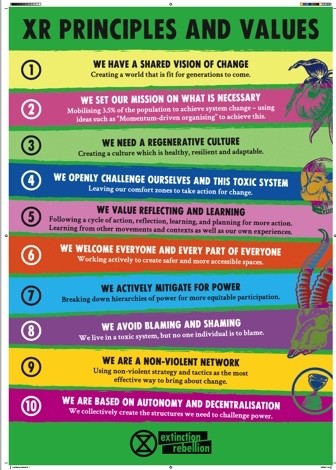
#### We have ten **Principles and Values**
Anyone who follows these core principles and values can take action in our name. _(This text includes the longer version of these, the printable page below the shorter version.)_
>**1. We have a shared vision of change:** creating a world that is fit for the next 7 generations to live in.
>
>Our hearts tell us a different world is possible. Our vision of change is sufficiently broad that it can contain a variety of opinions on how best to work towards that change:
>**2. We set our mission on what is necessary:** mobilising 3.5% of the population to achieve system change – such as “momentum-driven organising” to achieve this.
>
>We recognise that our job may be less about *“saving the world”* and more about trying to develop our resilience as multiple collapses take places.
>**3. We need a regenerative culture:** creating a culture which is healthy, resilient and adaptable.
>
>Regenerative culture includes a healthy focus on mutually supporting categories of; Self Care, Action Care, Interpersonal Care, Community Care, and People & Planet Care.
>**4. We openly challenge ourselves and this toxic system:** leaving our comfort zones to take action for change.
>
>We have a duty to disobey this system which destroys life on earth and is deeply unjust and some of us will undertake open (“*above ground*”) actions that risk arrest and charges.
>**5. We value reflecting and learning following a cycle of action, reflection, learning, and planning for more action. Learning from other movements and contexts as well as our own experiences.**
>
>We don’t know how things will change so we are willing to experiment and learn from what we do.
>**6. We welcome everyone and every part of everyone:** working actively to create safer and more accessible spaces.
>
>As a movement we are committed to campaigning for the right to life, and for the future life of our children and the planet.
>**7. We actively mitigate power:** breaking down hierarchies of power for more equitable participation.
>
>The ground on which this network stands is on the relationships between its participants. We will work every day to build trust, respect and reciprocity among all of us.
>**8. We avoid blaming and shaming:** we live in a toxic system, but no one individual is to blame.**
>
>Blaming and shaming will not serve us in the long run. Whilst a specific campaign may seek to highlight the damaging role played by an institution, including individuals serving that institution, our starting point is that we live in toxic system that has damaged everybody.
>**9. We are a nonviolent network:** using nonviolent strategy and tactics as the most effective way to bring about change.
>
>Non-violence keeps our movement alive. We use non-violence to reveal the true perpetrators of systemic violence that people suffer from daily all over this world.
>**10. We are based on autonomy and decentralisation:** we collectively create the structures we need to challenge power.**
>
>Anyone who follows these core principles and values can take action in the name of Extinction Rebellion.
----------
There is a further information on each of our [Principles and Values](https://extinctionrebellion.uk/the-truth/about-us/) on the XR UK web site. Click on each principle there to see the full description and explanation.
If you would like a colourful poster of the Principles and Values, a high-resolution image is available via the page [Principles and Values](/link/253) on the Arts shelf.
[>> NEXT PAGE: How you can get involved](https://rebeltoolkit.extinctionrebellion.uk/books/rebel-starter-pack/page/how-you-can-get-involved)
[>> Back to Rebel Start Pack CONTENTS](https://rebeltoolkit.extinctionrebellion.uk/books/rebel-starter-pack)
# How you can get involved
Extinction Rebellion is made of people from various backgrounds, ethnicities, communities and identities. **Here are some different ways of connecting with people within the UK:**
* #### Take part in actions
See our events calendar for details of coming actions on
[our XR events page](https://extinctionrebellion.uk/act-now/events/)
* #### Get involved in your community
Connect with other people in your area by joining **a Local Group.**
Find the closest one to you [on our interactive map linked here](https://map.extinctionrebellion.uk)
Connect with communities of shared self-identity (e.g. faith, occupation) by joining a **Community Group:**
[Community Groups' list and contacts on our website](https://extinctionrebellion.uk/act-now/resources/communities/community-groups/)
* #### Help organise our movement
Organise with us at a regional, national or UK level. Apply for available roles or set up an online CV.
Contribute your skills to help drive our movement via our [XR Volunteer Website](https://volunteer.extinctionrebellion.uk)
* #### Support us in another way
Consider donating. You can learn more here at [extinctionrebellion.uk/donate](https://extinctionrebellion.uk/donate)
Ask your MP to support the [Climate and Ecology Bill](https://www.ceebill.uk/sign-up) (external link)
---------
**We are a global movement**
You can connect with rebels around the world by visiting the XR [Global Website](https://rebellion.global)
[>> NEXT PAGE : How you can learn more](https://rebeltoolkit.extinctionrebellion.uk/books/rebel-starter-pack/page/how-you-can-learn-more)
[>> Back to Rebel Start Pack CONTENTS](https://rebeltoolkit.extinctionrebellion.uk/books/rebel-starter-pack)
# How you can learn more
Rebellion Academy is a website for both new and existing rebels who want to know more about how to get involved. Once you have created an account
you have access to:
• more information about XR
• a quiz to find out what type of rebel you are
• online trainings to help you find and prepare for your ideal role within XR.
[uk.rebellion.academy](https://uk.rebellion.academy/)
[>> NEXT PAGE: How we organise](https://rebeltoolkit.extinctionrebellion.uk/books/rebel-starter-pack/page/how-we-organise)
[>> Back to Rebel Start Pack CONTENTS](https://rebeltoolkit.extinctionrebellion.uk/books/rebel-starter-pack)
# How we organise
We work in small groups using a **self-organising system (SOS)**. Some groups operate at a UK-wide level, others at a regional/national level and others again at a local level.
We are also creating a network of **affinity groups**: small groups of people who work together at actions.
Each role and group within XR has a **mandate**. This tells those in that role or group what they can do and lets others know what they are responsible for.
Any person or group can take action in the name of XR so long as the action fits within our principles and values. There is no need to ask for permission.
We are working to build a movement that is **participatory, decentralised and inclusive**.
[>> NEXT PAGE: How our online meetings work](https://rebeltoolkit.extinctionrebellion.uk/books/rebel-starter-pack/page/how-our-online-meetings-work)
[>> Back to Rebel Start Pack CONTENTS](https://rebeltoolkit.extinctionrebellion.uk/books/rebel-starter-pack)
# How our online meetings work
Many of our online meetings use Zoom. You don't need an account to join a meeting, just:
1. Open an internet browser.
2. Go to zoom.us/join
3. Enter your meeting ID (provided by the organiser)
4. Click Join
[This video shows how to set up Zoom](https://youtu.be/fGbpwZNW3oI) if you haven't used it before:
##### Most of our meetings have:
**Check-ins:** where we introduce ourselves and share how we are doing.
**A Regenerative Culture Reminder:** we remind ourselves to be kind to one another as parts of XR, and that we don't blame or shame. We pay attention to our feelings and no-one takes on too many tasks. If we feel overwhelmed we can ask for help.
**A facilitator:** one person is designated to make sure everyone is heard and that we stay on task.
**A minute taker:** one person writes down the key things mentioned in the meeting.
**Check-outs:** we briefly say how we feel the meeting went or what we are each looking forward to today.
We use hand signals in our meetings to avoid talking over one another. These are the most common ones:
#### Hand Signals
__Point (or ‘I would like to speak’):__
When someone in the group wants to say something, they should point their index finger up and wait for the facilitator to let them have their turn in speaking. It is vital that people do not talk over anyone else and wait for their turn. If someone, who has not yet said anything, puts their finger up to speak, whilst others have spoken a lot, then the facilitator should give that person priority over the 'stack' (the queue or order of speakers based on the order they raised their finger to speak).
__Direct Point:__
If someone has directly relevant information to what is being said, then they can make the 'direct point' hand signal and the facilitator will let them provide that information immediately after the person speaking has finished. Think of the direct point hand signal as being like brackets, which are used to add critical information that a speaker is not aware of e.g. “the meeting has now been changed to Wednesday”. The direct point signal is not an excuse to jump the queue just to make a point. It is important that people do not abuse this signal as otherwise it can make all present lose trust in the process.
__Wavy Hands (I Agree):__
The 'wavy hands' signal of approval is used to show agreement or support for something someone has said. It instantly indicates how much consensus there is towards something and can highlight how popular an idea is. If everybody erupts into a forest of waving hands during a breakout session, for example, the note taker can see that this is one of the more popular points made and it will become one of the key bullet points fed back to the main meeting room.
__Clarification:__
If someone says something that is unclear, people can hold their hand in a ‘C’ shape as the 'clarification' signal. The facilitator will then pause the discussion giving the person who made the signal the opportunity to ask a question to clear up any confusion. This signal should be given priority above all others as it means that someone does not understand something and it may thus inhibit their ability to engage in the discussion.
__Technical point:__
If someone has information that is immediately relevant to the running of the meeting, they make a 'technical point' signal by making a ‘T’ shape with their hands. This is only to be used for concerns external to the discussion that need to be addressed immediately e.g. “We only have ten minutes of this meeting left” or “I am the note taker and I need the loo so can someone else take over?” The facilitator should stop the discussion to address the technical point.
__Round Up:__
Facilitators need to ensure that no one speaks for more than necessary (two minutes is a suggested maximum amount of time as it encourages people to be concise). If someone has been speaking for two minutes (or whatever the set amount of time is), the facilitator makes the ‘round up’ hand signal by repeatedly making a circular motion with their hands (as if they are tracing a ball). This must be done sensitively, but firmly as it ensures that no one person dominates the meeting.
__Speak up:__
If someone is speaking too quietly or they cannot be heard, others can ask them to raise their voice by raising and lowering their hands with palms open and facing up.
[>> NEXT PAGE: Climate grief and anxiety](https://rebeltoolkit.extinctionrebellion.uk/books/rebel-starter-pack/page/climate-grief-anxiety)
[>> Back to Rebel Start Pack CONTENTS](https://rebeltoolkit.extinctionrebellion.uk/books/rebel-starter-pack)
# Climate grief & anxiety
The crisis we find ourselves in can cause us very real and painful emotions such as grief, hopelessness and anxiety.
### Telephone Active Listening
Extinction Rebellion has a Trained Emotional Support Network (TESN). You can make a request to speak with a trained and vetted Rebel Active Listener by emailing Rebel2Rebel@tesn.uk
**(Please note that this is not a counselling service.)**
Watch [this video](https://www.youtube.com/watch?v=Di-Ha7pd3lU&feature=youtu.be) to learn more (2 mins)
### Counselling or Psychotherapy
The [Climate Psychology Alliance (CPA)](https://www.climatepsychologyalliance.org/index.php/find-support) provides a list of Practitioners offering three free sessions of therapeutic support to activists.
**(Please note that the practitioners have not been formally vetted so it is up to you to confirm their suitability.)**
***
If you have a query about either of these services you can email xr-tesn@tesn.uk. TESN are not involved in any actions, but if you feel the information you wish to share is particularly sensitive please use
XR-TESN@Protonmail.com instead.
[details about TESN on the XR UK main website](https://extinctionrebellion.uk/act-now/resources/wellbeing/tesn/)
[>> NEXT PAGE: Glossary](https://rebeltoolkit.extinctionrebellion.uk/books/rebel-starter-pack/page/glossary-for-new-rebels)
[>> Back to Rebel Start Pack CONTENTS](https://rebeltoolkit.extinctionrebellion.uk/books/rebel-starter-pack)
# Glossary for new rebels
##### We do our best but know we can lapse into jargon sometimes! Here are some terms and acronyms we think new rebels are most likely to need.
##### To find a fuller list go to our [**Glossary of Terms**](/link/73) page.
________
* **Action Network (AN)**
The system we use to keep records of XR subscribers and send out mailings and newsletters.
_________
* **Action Point (AP)**
Record of a specific task someone agrees to take on, usually at a meeting.
________
* **Affinity Group (AG)**
Small groups of people who work together at actions.
______
* **Citizens’ Assembly (CA)**
Innovative bodies that can empower people, communities and entire countries to make important decisions in a democratic way.
________
* **Community Group**
A group brought together by identity e.g. faith, culture, occupation or really anything! e.g. XR Grandparents, XR Muslims, XR Doctors etc.
_________
* **Coordinator**
1. Internal Coordinator (IC) Manages the relationships within the group.
2. External Coordinator (EC)
Manages the group’s relationship with other groups.
______________
* **DNA**
The things that make us XR. These include our Principles & Values, Self-Organising System, Ways of Working etc.
____________
* **Glassfrog**
The old XR UK organisational diagram. This has now been replaced by [the Hub](/link/420) described below, which now also holds details of Working Groups and Local Groups and their relationships. You can find the public facing version of the organisational diagram at [organism.extinctionrebellion.uk](https://organism.extinctionrebellion.uk/)
__________
* **Hub - also known as CommsHub**
A webpage which gives access to our online communications tools:
1. Mattermost (MM): Instant chat, connecting all of XR worldwide
2. Forums: Longer discussions on particular topics
3. Cloud: Storage for documents
The Hub is specifically for XR in the UK and can be found at [auth.extinctionrebellion.org.uk](https://auth.extinctionrebellion.org.uk/)
_________________
* **Nonviolent Direct Action (NVDA)**
The practice we use to achieve our goals of social change. It includes protests, civil disobedience and economic and political non-cooperation.
______________
* **Peoples’ Assembly (PA)**
A brain storming tool for big groups that empowers people to share their ideas and opinions.
____________
* **Rebel**
Anyone who joins us and commits to our principles and values.
_______________
* [**Rebel Agreement**](https://extinctionrebellion.uk/wp-content/uploads/2019/10/XR-REBEL_AGREEMENT_A6_Flyer-FINAL-NO-CROPS.pdf)
Five rules which rebels should adhere to on actions.
____________
* **Regenerative Culture**
The principles of care, mutual respect and listening we try to abide by.
__________
* **Self-Organising System (SOS)**
Our system of organising. It is how we make decisions, define roles, structure ourselves and evolve as we learn what works and what doesn’t.
____________
* [**Volunteer agreement**](https://actionnetwork.org/forms/xr-data-protection-agreement-2?source=direct_link&)
Our principles and values and data protection policy.
____________
* **Working Group (WG) (or ‘circle’ or ‘team’)**
A group of people who do a particular type of work e.g. talks and trainings (T&T), media and messaging (M&M).
[>> NEXT PAGE: WHY XR?](https://rebeltoolkit.extinctionrebellion.uk/books/rebel-starter-pack/page/why-xr)
[>> Back to Rebel Start Pack CONTENTS](https://rebeltoolkit.extinctionrebellion.uk/books/rebel-starter-pack)
# Why XR?
*These two short videos (not in the pdf version) explain where Extinction Rebellion came from and why people have joined since.*
**1. A mixture of people and their reasons for joining XR:**
[Why we joined XR](https://www.youtube.com/watch?time_continue=6&v=pTR1JqjbD3Q&feature=emb_logo)
**2. How extinction Rebellion Started:**
[How XR Started](https://www.youtube.com/watch?v=2P6UJyaeT4M&feature=emb_logo)
[>> Back to Rebel Start Pack CONTENTS](https://rebeltoolkit.extinctionrebellion.uk/books/rebel-starter-pack)